
When a major economy raises tariffs on coffee from a specific country, the decision is often framed as bilateral. A dispute between two states. A sanction aimed at a single flow. In reality, the effect is neither contained nor local.
The coffee does not stop moving. The market recalibrates.
A tariff imposed by the United States on coffee from Country A immediately breaks the direct economic logic of that origin. The product becomes too expensive for American buyers, regardless of quality or demand. For producers and exporters, access to the U.S. market closes, not because the coffee is unwanted, but because the route has become politically priced.
The Buffer Mechanism
The response is not confrontation. It is adaptation. Coffee from Country A is redirected through neighboring countries, typically those with logistical capacity, existing export infrastructure, and preferential access to global markets.
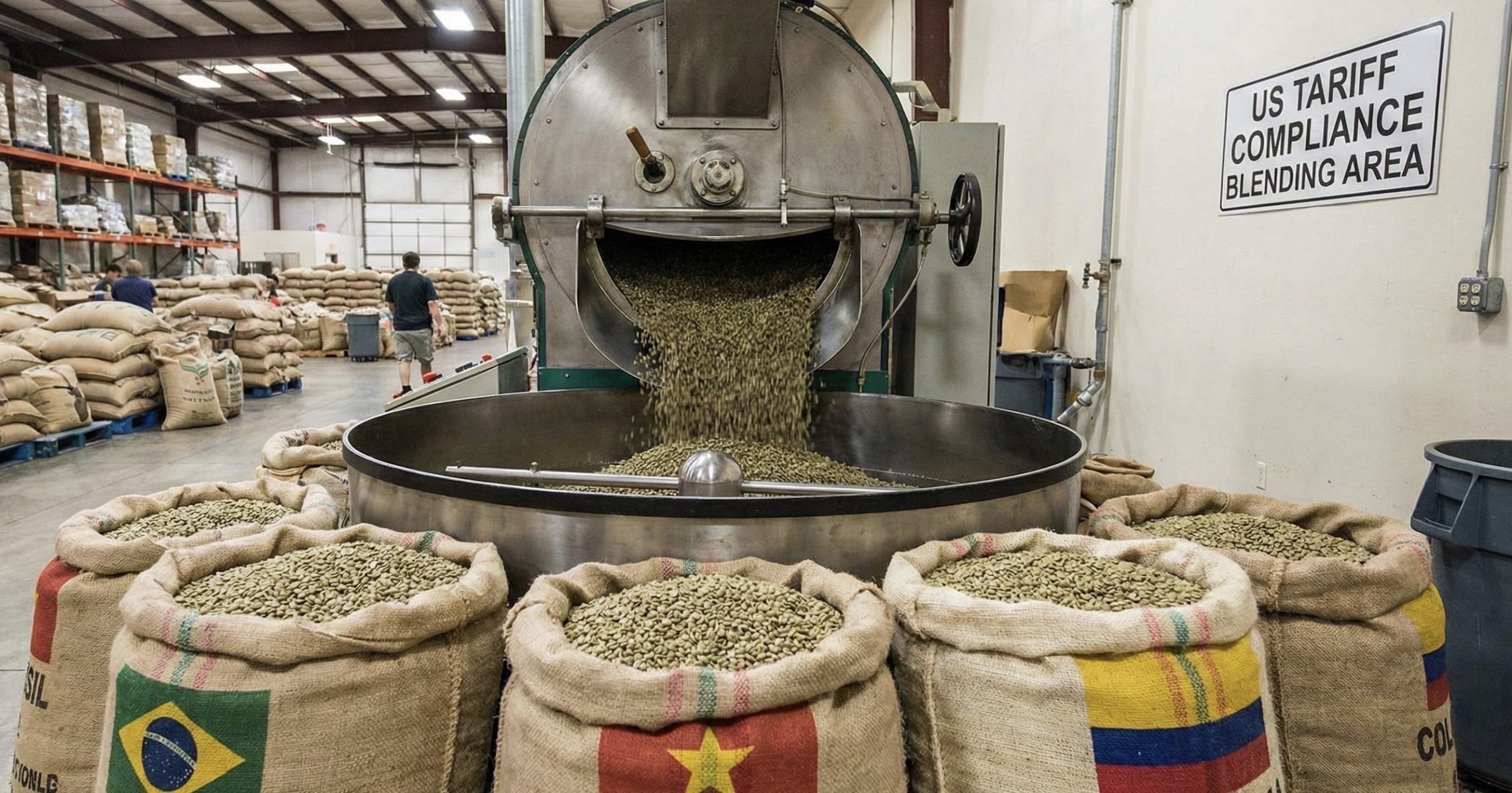
Country B becomes a buffer. Not a producer, but a filter. The coffee crosses borders, warehouses, and customs zones, until its origin becomes a variable rather than a fact.
From that point, the transformation is procedural. Documentation is adjusted. Invoices realigned. Certificates reissued. In more advanced cases, physical blending is introduced, creating a product that is legally coherent and materially indistinct. The coffee leaves under a different flag, carrying a different story, and enters markets that were never part of the original tariff decision.
A Systemic Contagion
This is where the risk becomes systemic. The distortion does not remain limited to U.S. imports. Once origin laundering is operational, the same coffee can circulate toward Europe, the Middle East, or Asia.
Trade statistics shift. Supply signals blur. Countries that did not impose any tariffs suddenly import volumes that do not correspond to their declared sources. Risk migrates across markets.
- For buyers, the first impact is informational. Origin loses reliability. Certifications and export documents remain formally correct, but strategically hollow.
- For financial institutions, the exposure is indirect but real. Trade finance and counterparty risk assessments rely on assumptions about jurisdiction. When those assumptions are wrong, credit risk is mispriced.
- For regulators, enforcement based on documents alone cannot scale against adaptive logistics.
« Tariffs do not eliminate trade. They incentivize opacity. »
The Quiet Failure
In such an environment, risk does not announce itself through crises. It accumulates silently, embedded in flows that appear compliant, diversified, and stable. Until they are not.
When origin becomes negotiable, exposure is no longer a question of ethics or intent. It is a question of system design. And systems, once distorted, rarely correct themselves without pressure.